


Summer is the perfect time to connect with children and teens to determine how you will work together to ensure you are all prepared for new risks as they get older. New schedules, new caregivers, more time online, and potentially less supervision mean new vulnerabilities, and with the right preparations and conversations, you can all have the relaxing fun summers you deserve!
SAFE ADULTS
As kids get older, we slowly release more responsibility, but they will always rely on adults for safety – especially those who are still little. Every child and teen needs at least one Safe Adult in their life. Someone they can turn to if they feel scared, unsure, or have been hurt—and that person can be YOU!
As an adult, being someone a child trusts with sensitive conversations is one of the most important roles you can play in keeping them safe. A Safe Adult is someone who can get a child help when they need it, respects and upholds safety boundaries without ever asking a child to cross them, and is someone the child feels comfortable opening up to about difficult or uncomfortable topics.
Resources:
- All About Safe Adults—https://mbfpreventioneducation.org/safe-adults/
USE THE MBF 5 SAFETY RULES©
The MBF 5 Safety Rules are taught through MBF Prevention Education Programs. The Safety Rules are strategies designed to help children and teens prevent, recognize, and
respond to abuse, bullying, and other types of victimization.
- Safety Rule #1 – Know What’s Up
- Safety Rule #2 – Spot Red Flags
- Safety Rule #3 – Make A Move
- Safety Rule #4 – Talk It Up
- Safety Rule #5 – No Blame | No Shame
Learn more about the MBF 5 Safety Rules by visiting—https://mbfpreventioneducation.org/mbf-5-safety-rules/.
Here’s a video you can watch with your child to teach them about the 5 Safety Rules.
SUMMER CAMP SAFETY
Sending your child to summer camp can be an exciting and rewarding experience for both kids and parents. Whether it’s their first time away or they’re seasoned campers, preparation is key to ensuring a safe, smooth, and enjoyable adventure.
Questions You Should Ask – Give camps a call or email them the questions below—
- Can you confirm whether your camp is accredited by the American Camp Association, and if so, whether your accreditation is current?
- Could you outline the child safety training that your counselors and staff are required to complete (e.g., abuse prevention, first aid, emergency response)?
- What is your typical counselor-to-camper ratio across different age groups?
- Do you have a policy that prevents a single staff member from being alone with a child? If so, how is this implemented in daily operations?
- How does your camp handle behavioral or disciplinary issues, and how are parents informed if concerns arise?
Even if your child is not attending a summer camp program, they may still encounter many new places. Whether they are having a sleepover at a friend’s house, attending music lessons, or going on a family vacation, it is important to keep them safe at all times.
DIGITAL SAFETY
Screens are a big part of kids’ lives today, and it’s not always easy to find the right balance. Some teens may struggle to unplug, and too much screen time can impact sleep, mood, and well-being. With a few thoughtful guidelines and routines, you can help kids develop healthier habits without it becoming a constant battle, while also understanding the risks that exist online.
RESOURCES
- Protect Your Child From Online Predators: Free Digital Parenting Guide (By Thorn) — https://info.thorn.org/safe-connections-guide
- BLOG: Fostering Digital Safety at Home
- How to talk with teenagers about sexting: 12-18 years— https://raisingchildren.net.au/teens/entertainment-technology/pornography-sexting/sexting-teens
- Parents’ Guide to Teen Sextortion Scams – https://connectsafely.org/sextortion/
- Common Sense Video Game Reviews — https://www.commonsensemedia.org/game-reviews
- Video Game and Books Reviews — https://www.familygamingdatabase.com/
- Family Tech Safety Planning – https://www.commonsensemedia.org/family-tech-planners
- New Ways to Support Teens and Families on YouTube – https://blog.youtube/news-and-events/updates-youtube-supervised-accounts-teens/
- FBI’s Safe Online Surfing Program—https://sos.fbi.gov/en/
- NEMEC’s Into the Cloud Animated Series— https://www.netsmartzkids.org/into-the-cloud/
CYBERBULLYING
If Your Child Is Being Cyberbullied:
Finding out your child is being cyberbullied can be upsetting, but how you respond makes a big difference. Here are some steps to take:
Stay calm and listen. Let your child share what happened without interrupting or overreacting. They need to feel heard and supported, not judged.
Document everything. Take screenshots of all bullying messages, posts, or images before blocking the bully. This evidence may be needed later.
Don’t retaliate. Encourage your child not to respond to the bully, and resist the urge to reach out to the other child or their parents on your own, as this can escalate the situation.
Report and block. Report the bullying behavior to the platform or app where it occurred and block the person responsible.

If Your Child Is Participating in Cyberbullying:
If you become aware that your child has been engaging in harmful online behavior, it’s an important opportunity to step in, guide them, and help them make healthier choices moving forward. Here’s how to respond:
- Stay calm, but be firm. Have an honest conversation with your child about what they did and why it is harmful. Avoid shaming them, but make it clear that this behavior is unkind and unacceptable.
- Try to understand why. Sometimes cyberbullying is a sign of deeper issues like insecurity, social struggles, or even that your child may be experiencing bullying themselves. Ask questions and really listen.
- Set clear consequences. Establish firm boundaries around technology use and follow through with consequences if the behavior continues.
- Stay Involved and Connected Online. Instead of just monitoring, create regular check-ins around their digital life. Review apps together, talk about what they are seeing or experiencing online, or even spend time using games and platforms together.
Open communication and early action are key. Keep the lines of conversation open so your child feels comfortable coming to you when problems arise online.
Resources:
- Here’s a short film to watch with your child to help start the conversation about cyberbullying and how to be an Upstander: Are You Okay? By the Barbara Sinatra Children’s Center Foundation—https://youtu.be/tJsGGsPNakw?si=gWKLvEV7eQYGcODG
HEALTHY AND UNHEALTHY RELATIONSHIPS
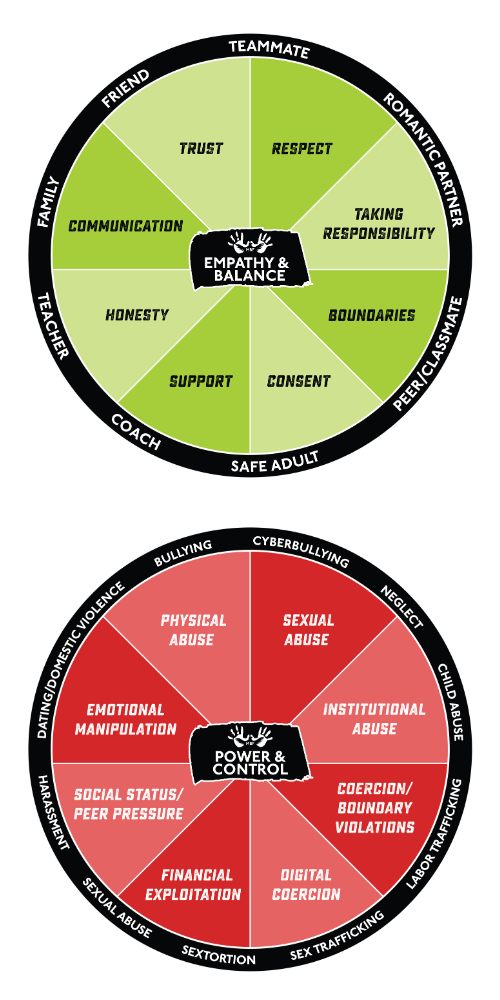
Healthy relationships matter at every stage of life. Relationships should feel safe, respected, and supported, but not all relationships are healthy. Some relationships can turn dangerous, and it’s important to help kids recognize the warning signs early. The MBF Relationships Wheels are a powerful tool that can help youth learn how to continue building healthy relationships, both online and in real life.
Healthy vs Unhealthy Relationships
Healthy Relationships
The Healthy Relationship Wheel teaches the positive qualities that make relationships safe and supportive, like respect, kindness, trust, good communication, empathy, and balance. Just as a green traffic light signals “go,” these traits signal that a relationship is healthy. By learning to identify and practice these qualities, teens build the skills to foster strong connections, feel seen and valued, and prevent unhealthy relationships before they start.
The Abusive Relationships Wheel illustrates how power and control can be used to harm others. When someone repeatedly uses their power, whether through age, authority, or force, to limit another person’s freedom or well-being, it becomes abuse. Each section of the wheel represents a different abusive behavior, with types of abuse on the outer rim. Learning to recognize these behaviors is key so that teens know when something isn’t right and when it’s time to talk to a trusted Safe Adult.
Experiencing an abusive relationship can make it harder for young people to feel supported or safe. Traffickers and predators deliberately take advantage of these situations, targeting youth both online and in real life.
You can also reach out to the Boys Town National Hotline (it’s for everyone!) at 800-448-3000 or text “VOICE” to 20121. There is always help available, and you are never alone.
Watch Mia’s Story to start the conversation—This animated video series illustrates the experience of a young girl being trafficked through the lens of the different individuals in her life. The story begins with Mia meeting her trafficker through social media. (DHS Video by Blue Campaign/Released)
- Mia’s Story — https://www.dhs.gov/medialibrary/assets/video/27904
If you suspect someone is in an unsafe or unhealthy relationship, trust your instincts and support them in getting help.
For Teens, reach out to the National Teen Dating Abuse Helpline at 1-844-762-8483 or text LOVEIS to 22522
For Adults, reach out to the National Domestic Violence Hotline at 1-800-799-SAFE or text START to 88788
BODY SAFETY AND SETTING BOUNDARIES
Talking to your child about body safety and personal boundaries is one of the most important conversations you can have as a caregiver. It may feel uncomfortable or difficult to know where to start, but these conversations don’t have to be complicated, and having them early can make a powerful difference in keeping your child safe.
By having these open, age-appropriate conversations, you are not taking away your child’s innocence; you are giving them the knowledge and confidence they need to protect themselves.
Remember, you don’t have to cover everything in one conversation. Start simple, stay calm, and remind your child that their body belongs to them and that they can always come to you no matter what.
- DISCUSS BOUNDARIES. Let your child and other adults know that physical contact is your child’s choice based on their own comfort level. If a child says “no” or “stop,” that decision must be respected by everyone.
- PAY ATTENTION TO SIGNS OF ABUSE. It can be easy to dismiss concerns when the adult in question is a family member or trusted friend, but 90% of child sexual abuse is committed by someone the child and family know, and 70% by a family member. If something feels off, act on it — ask questions, drop in unannounced, and always follow up with your child after time spent with others to make sure they feel safe.
- EXPLAIN SECRETS VS. SURPRISES. Help your child understand the difference between secrets and surprises. Surprises are fun and short-lived, like gifts or parties, while secrets are often used by abusers to keep children silent. Teach your child that if anyone — adult or child — ever asks them to keep a secret, they should tell you or a trusted adult right away.
- LIMIT ONE-ON-ONE SITUATIONS. Since 80% of child sexual abuse occurs in one adult-one child situations, try to limit or eliminate these opportunities when possible. When alone time can’t be avoided, make sure it remains observable and interruptible, and let the adult know you may drop in unannounced. Keep in mind that one-on-one time between children also carries risk, as 30% of abuse cases involve another youth.
Resources for Children
- Resources to Teach Body Safety— https://www.childsafety.gov.au/having-conversations/resources-teach-body-safety
- How to Talk with Kids About Personal Safety and Sexual Abuse—https://cfccdn.blob.core.windows.net/static/pdf/hot-chocolate-talk/hot-chocolate-talk-2023-conversation-guide.pdf
- Child sexual abuse: talking to children (Suitable for 0-11 years)—https://raisingchildren.net.au/school-age/safety/child-sexual-abuse/child-sexual-abuse-talking-to-children
- Child sexual abuse: talking to teenagers (Suitable for 12-18 years)—https://raisingchildren.net.au/teens/communicating-relationships/tough-topics/child-sexual-abuse-talking-to-teens
ADDITIONAL RESOURCES
Summer Activity Ideas
Outdoor Fun & Adventure
- Backyard Water Fun: Set up a sprinkler, water balloon dodgeball, or a water bounce house.
- Nature Exploration: Hike local nature trails, go birdwatching, or go fishing.
- Backyard Camping: Set up a tent, tell stories, and make s’mores, as suggested by and.
- Garden Projects: Start a small garden with fruits, vegetables, or flowers.
- Active Play: Bike riding, visiting new playgrounds, or playing outside games like tag/hide-and-seek.
Creative Indoor Activities
- DIY Craft Corner: Create a dedicated, rotating craft space for projects.
- Cooking and Baking: Let kids bake cookies, make homemade pizza, or create a “make your own sundae” station.
- Build a Fort: Create a cozy hideaway using blankets, pillows, and furniture.
- Educational Fun: Use free online tools like Art for Kids Hub or listen to stories told by astronauts on Story Time from Space.
- Science Experiments: Make slime or create a glass bottle water xylophone.
Educational & Community Engagement
- Summer Reading: Sign up for a local library reading program to keep brains active.
- Journaling: Have kids spend time writing or sketching in a daily journal.
- Community Service: Bake cookies or make cards for neighbors, or hold a toy drive to gather donations.
- Scavenger Hunts: Organize a photo scavenger hunt around the house or neighborhood.
Budget-Friendly & Seasonal Ideas
- Free Events: Check local listings for free library events, splash pads, or nature centers.
- Summer Bucket List: Create a list of 50+ activities to check off, helping kids pick an activity each morning.
- Movie Night: Set up a backyard movie night with a projector, or attend a drive-in movie.
Download Darkness to Light’s Summer of Safety Resource Guide
This guide is designed to help you confidently navigate conversations with children, recognize signs of unsafe situations, and take proactive steps to create safer environments. With practical tips, checklists, and actionable guidance, you’ll be equipped to protect the children in your life and empower them to feel heard, supported, and safe all summer long.

Keeping kids safe during the summer requires more than just supervision—it calls for intentional guidance, open communication, and consistent use of proven safety strategies. By teaching and reinforcing the MBF 5 Safety Rules—helping children understand their environment, recognize red flags, take action, speak up, and know they are never to blame—adults can empower kids to make safer choices in any situation. Just as importantly, being a trusted “Safe Adult” means creating a supportive environment where children feel heard, believed, and protected.
Paid by OAG, GR-2025-Monique Burr Foundation for Children-00006