

The MBF Safety Matters Theory of Change (ToC) is our blueprint for making children safer. It maps out exactly how our work leads to real, lasting results — not just what we do, but why it works.
We know that harm rarely happens in isolation. Children who experience one form of abuse or violence are significantly more likely to experience others — a pattern known as polyvictimization. These children face compounding trauma that can affect their health, relationships, and well-being for years to come. Stopping harm early and addressing it completely is the only way to break that cycle.
That’s why our approach connects three things that research shows must work together:
Systems that back it all up — schools and communities structured to identify patterns of victimization early and make safety a priority, not an afterthought.
Safety education that meets kids where they are — lessons designed for each age and stage of development, so children can actually understand and use what they learn.
Adults who are trained and ready to help — because children need trusted grown-ups who know how to recognize multiple forms of harm, respond appropriately, and follow through.

When these three pieces are in place, the results are measurable: children build real skills, behavior changes, and rates of harm go down — including for the most vulnerable children who are at greatest risk of experiencing harm again and again.
The MBF Safety Matters ToC is our guarantee that safety education doesn’t just happen — it works. It holds us accountable to outcomes that matter: fewer children victimized, fewer children caught in cycles of repeated harm, and safer schools and communities for everyone.
The MBF ToC is a comprehensive framework that clearly explains how and why our long-term goals are achieved. It serves as a strategic roadmap, outlining how our developmentally appropriate, prevention-focused safety education to youth—combined with trained, supportive adults and system-level support—will lead to reduced victimization and safer school and community environments. Our ToC ensures that prevention education is not just delivered—but delivered in a way that reliably builds skills, changes behavior, and reduces harm for children over time.
MBF Safety Matters’ Theory of Change
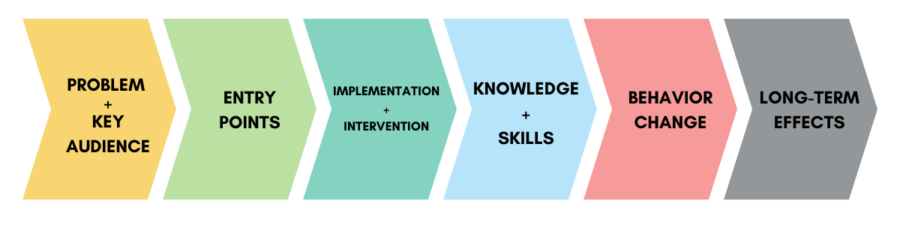
The pathway below shows how we move from problem to impact — from the realities of childhood victimization, through the actions we take and the skills we build, that result in safer schools, communities, and ultimately – safety for every child.
Problem: Youth are susceptible to multiple forms of victimization and are disproportionately vulnerable due to developmental factors and systemic inequities.
Our Key Audience:
- All students, from Pre-K through 12th grade
- Differentiation for diverse learning styles, multilingual students, and students with disabilities
- Adults with violence prevention responsibilities (e.g., mandatory reporters, youth serving organizations (YSO) and out-of-school (OST) time personnel, school counselors )
- Adults with ongoing engagement with youth (e.g., educators, coaches, OST time personnel, counselors, parents/caregivers)
Our starting point for addressing the problem:
- PreK–12th grade classrooms
- Out-of-school time (OST) settings (after-school programs, summer camps, athletic programs)
- Community partnerships (e.g., child advocacy centers, youth-serving organizations, parent-teacher organizations)
- Alignment with state education standards, Erin’s Law, Jenna’s Law, school-wide Social Emotional Learning (SEL) initiatives, and Multi-Tiered System of Supports (MTSS) frameworks
- System-level support
Provide a comprehensive prevention education program to youth that includes classroom-based lessons involving developmentally aligned strategies, such as scenario-based learning, role-playing, and interactive storytelling:
- Teach/reinforce the MBF Five Safety Rules
- Identify/talk with Safe Adults and Safe Friends
- Overall prevention knowledge and awareness
- Emotional regulation
- Bystander/upstander intervention
- Respectful interactions and inclusion
- Personal space and boundaries; asking permission before touching or using belongings
- Body safety and recognizing safe vs. unsafe touches
- Using words to express feelings and ask for help
- Inclusion of multilingual and students with Intellectual and Developmental Disabilities (I/DD) (culturally responsive)
- Conduct pre/post assessments
Youth apply these program lessons to their lives (online and in real life):
- Recognizing safe and unsafe situations, both in-person and online
- Using words to express feelings and ask for help from Safe Adults
- Practicing self- awareness, calming strategies, and kindness toward others
- Understanding personal boundaries and noticing when someone’s behavior feels wrong or unsafe
- Learning how to say ‘no,’ leave unsafe situations, and keep asking for help until someone listens
- Knowing who safe adults are and feeling comfortable talking to them when something feels unsafe
- Practicing online safety
Youth and adults apply healthy relationship skills in their lives and know how to respond to potential abuse and victimization online and in real life.
- Increase in healthy relationship behaviors; appropriate boundary setting; awareness of what constitutes abusive behavior; and consent-based behaviors between peers and between youth and adults
- Recognize when something feels unsafe (in-person and online) and use simple strategies to get safe (leave, tell a Safe Adult, keep asking for help)
- Identify and talk to Safe Adults at school, outside of school and home for help
- Practice upstander behaviors: help friends in safe ways and speak up when someone is treated unfairly
- Show safe choices consistently across school, home, and online settings
- Understand personal boundaries and notice boundary-crossing behaviors; tell a Safe Adult
- Improve when/how adults report boundary violations
- Build SEL skills: name feelings, use calming strategies, solve problems, and show kindness
- Improve school climate: fewer bullying behaviors; more kindness, fairness, and belonging
- Increase help-seeking and disclosure: more students tell Safe Adults when something feels wrong
- Strengthen adult–child trust through consistent, trauma-informed responses and clear reporting pathways
Reduced victimization & violence towards and by youth:
- Increase in healthy relationship skills, between peers and between youth and adults
- Fewer unsafe situations and less bullying
- Students identify red flags (in person and online)
- Students use simple strategies to get safe: leave, tell a Safe Adult, keep asking for help
- Students speak up for themselves and help friends safely
- Classrooms feel safer and kinder, with more fairness and respect
- Students know Safe Adults and feel comfortable talking to them
- Students learn body safety rules and personal boundaries; how and then tell a Safe Adult if a boundary is crossed
- Adults identify and report when they see boundary violations or areas of concern around a child’s safety
- Students build SEL skills: name feelings, calm down, solve problems, show kindness
- Stronger adult–child trust and consistent, trauma-informed responses