

MBF Prevention Education Programs are built using proven, up-to-date prevention best practices and methods. Our programs teach kids, teens, and adults about safety, healthy development, and how to recognize and respond to unsafe situations. The lessons are age-appropriate, trauma-informed, and interactive, and are presented in a fun and engaging way that increases knowledge, builds confidence and resistance skills, engages safe adults, and addresses risk and protective factors. Each lesson includes clear goals, ways to measure learning, and align to various school and health education standards. Our programs are updated annually, ensuring we stay on top of the latest research on how best to support children in staying safe.

EVIDENCE BASED PROGRAMMING
Our programs work! Through independent research studies, we measure our curriculum’s impact, ensuring that youth are learning important safety concepts through our program that will help keep them safe. On average, youth who participate in an MBF abuse prevention program demonstrate a 20% knowledge and skills gain. MBF Child Safety Matters®(for grades K–5th) is evidence-based, and MBF Child Safety Matters+ and Teen Safety Matters® (for grades 6th – 12th) are evidence-informed.
- Centers for Disease Control: MBF Child Safety Matters is a well-supported, evidence-based curriculum for elementary school students in grades K-5.
- California Evidence-Based Clearinghouse for Child Welfare: MBF Child Safety Matters is currently “1” on the rating scale, proving its effectiveness, rigorous study, and sustained impact on students who received the program.
We applies the same evidence-informed, research-based approach across all of our programs, which were developed based on the same theoretical knowledge and research best practices, ensuring the same quality and effectiveness: MBF Child Safety Matters-Pre–K, MBF After-School Safety Matters®, and MBF Athlete Safety Matters®.
MBF is committed to ongoing evaluation and research to ensure the impact of all our programs. When exploring which program is best for you, it’s important for schools, youth-serving organizations, communities, and funders to know whether a program has a proven track record, measured by independent evaluations and research that demonstrate it can realistically succeed in a real-world setting with the intended impact. In addition, through our Certified Facilitator Trainings, we partner with educators and facilitators to ensure they have the knowledge and skills to support program delivery that will have the desired impact.
Our programs are shaped by real-world experience. Developed, reviewed, and refined annually by education and prevention experts, the programs are not only effective but also acceptable and practical, and are used across the U.S. by thousands of facilitators with over 18 million children.
What Is “Evidence-Based”?
MBF is committed to research, transparency, and honest communication about our programs’ evidence base — because “evidence-based” means different things to different organizations; there is no single set of guidelines or criteria that must be met to make this claim. Because of this, it’s important to look closely at how a prevention program is supported by evidence and to ask questions about those claims. In assessing prevention programs, it is important to evaluate the strength of the research and whether the program can realistically succeed in real-world settings.
According to the Centers for Disease Control, “Evidence-based decision-making is a process for making decisions about a program, practice, or policy that is grounded in the best available research evidence and informed by experiential evidence from the field and relevant contextual evidence.”[1]
Strong evidence comes from careful, relevant research, repeated use across different settings and groups, and clear guidance that helps educators and facilitators implement the program correctly.
FOUNDATIONAL ELEMENTS
Safety Rules
One foundational element of MBF Programs is the MBF 5 Safety Rules©.
The MBF 5 Safety Rules, taught in all MBF Programs and supplemental modules, are strategies designed to help children, teens, and adults identify and respond to abuse, bullying, and other types of victimization.

Research shows that MBF’s Safety Rules are effective in teaching children and teens how to stay safe and prevent victimization:
Findings indicate that teaching kids about different types of violence and how to recognize safe vs. unsafe situations helps them stay safer and know when to get help.
Closely related to the findings for the first safety rule, research indicates that children and teens learn to recognize warning signs—both in person and online, such as manipulation, grooming, or unhealthy behaviors, so they can avoid risky situations.
Findings indicate that programs can help youth practice making safe choices, using protective measures in unsafe situations, treating others with respect, and knowing what to do if something doesn’t feel right.
Kids are more likely to speak up, set boundaries, and tell a trusted adult when they feel confident and supported. Strong relationships with Safe Adults (and Safe Friends) make a big difference. Much of the research on this rule indicates that it is important to take a holistic approach to children’s safety and to involve families and school personnel in creating a safe space where children feel comfortable leaving or calling out unsafe situations.
Research shows it’s critical for children to understand that violence is never their fault, especially since children who experience child abuse, bullying, or cyberbullying, exploitation, or who experience multiple types of abuse are likely to profess self-blaming beliefs or negative self-attribution or to engage in self-silencing. Programs that encourage help-seeking and normalize speaking up can reduce shame and support healing.
Safe Adults
Another foundation element is a Safe Adult, someone they can confide in if they ever feel unsafe, have been hurt, or are not sure whether a situation is unsafe. Children should be taught that if they have a Safe Adult now, and sometimes in the future, that Safe Adult doesn’t make them feel safe, they can always choose another Safe Adult.
Why do we ask children to identify “Safe Adults” instead of “trusted adults?”
Many children have adults in their lives they trust. And many children have also had trusted adults who have hurt them. Simply identifying trusted adults does not ensure those adults are safe. So, in addition to an adult a child trusts, we identify other factors that makes them a Safe Adult, such as someone that can and will help them, someone who doesn’t break the Safety Rules or try to get the child to break them, etc.

Healthy and Unhealthy Relationship Wheels
As children grow and become teens, it is vital that our approach adapts to reflect the world they live in. The MBF Empathy & Balance and Power & Control Relationship Wheels in Teen Safety Matters lay the foundation for understanding what makes relationships healthy or unhealthy. This shift reflects how risk and victimization change as students grow. Instead of immediately diving into specific types of abuse and prevention, we give students more tools and skills they can use to counteract or prevent any risk or harm that can happen at this age.
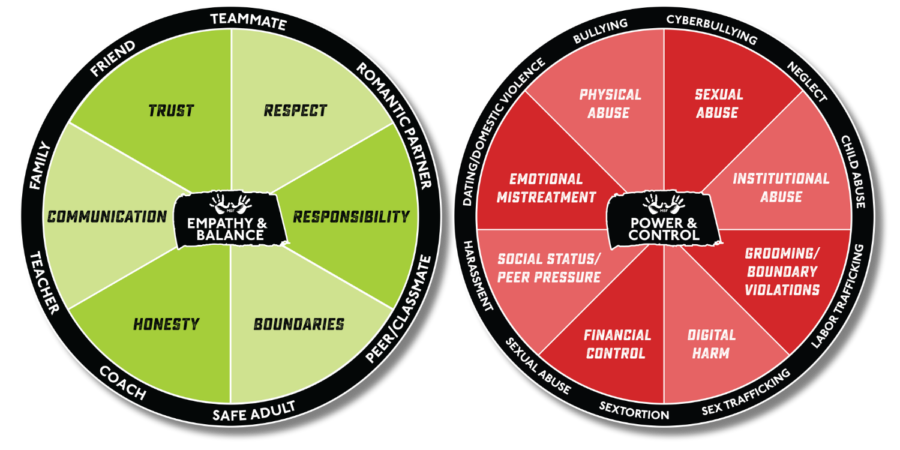
In Child Safety Matters, students learned about physical, emotional, and verbal aggression and how to recognize unsafe situations and people online and in real life. As they enter middle and high school, their experiences—and vulnerabilities—become more centered on relationships. We help students navigate the full range of relationships they will experience, both among themselves and with the different adults in their lives.
The Relationship Wheels help students move beyond general awareness by building a clear understanding of what safe, respectful relationships should look like, and what they look like when they are unsafe or abusive. They offer a framework in which students practice identifying the core characteristics of safe, respectful relationships, recognizing the red flags when a relationship can shift into unhealthy or abusive ones, and knowing what to do when that happens.