

OCTOBER IS BULLYING PREVENTION MONTH! Whether it is offline or online, many youth experience bullying, and it’s one of parents’ top concerns for their children. Bullying can come in many forms and is a growing issue for kids, not only in the US but across the globe. However, awareness, prevention education, and intervention are three very effective ways to stand against bullying.
BULLYING
Bullying involves deliberate and repeated aggressive actions by an individual or group directed toward someone with less power, resulting in physical, verbal, social, or psychological harm.
Bullying can occur in-person or online and in many forms (click to expand)
- Physical Bullying: Involves physical force or contact with the body, such as hitting, kicking, or shoving.
- Verbal Bullying: Uses words to cause harm, like name-calling, teasing, or threatening.
- Social or Relational Bullying: Aims to damage someone’s relationships or social standing, such as spreading rumors or excluding others.
- Digital: Also known as “Cyberbullying” (learn more about cyberbullying below)
To be considered bullying, an act must generally include:
- Repetition: The behavior happens more than once, or there is a high likelihood it will happen again.
- Intentional Aggression: The behavior is deliberate and meant to cause harm or distress.
- Power Imbalance: The bully uses their power, physical strength, social popularity, or knowledge of embarrassing information, to control or harm the victim.
Indicators of Bullying in Youth (click to expand)
- Frequent cuts or bruises
- Injuries without adequate explanation
- Voices frequent physical complaints
- Changes in sleeping/eating patterns
- Ripped/torn clothing upon return from school or other activity
- Missing items or valuables
- Suddenly reluctant to go to school or participate in sports/other activities
- Frequently loses money or other possessions
- Frequently spends time alone
- Seems sad or depressed
CYBERBULLYING
Cyberbullying is repeated online harassment. It differs from traditional bullying by being potentially anonymous, reaching a large audience quickly, and the content being difficult to remove, which can make it more hurtful. Cyberbullying can cause significant emotional and mental health issues, and sometimes it crosses into unlawful or criminal behavior.
How Cyberbullying Occurs (click to expand)
- Technology-based: It happens through apps, websites, social media, gaming platforms, text messages, and emails.
- Repeated and harmful: It involves sending, posting, or sharing negative, harmful, or false content about someone with the intent to cause harm.
- Targeted: While a stranger can be involved, it more often occurs between people who know each other from school or social settings.
Examples of cyberbullying:
- Sending mean or threatening messages
- Spreading embarrassing photos, videos, or untrue information
- Excluding someone from online groups, video games, or activities
- Creating fake accounts to impersonate or harass someone
- Trolling or sending harassing comments online
Indicators of Cyberbullying in Youth (click to expand)
- Spends large amounts of time online, especially at night or when alone
- Receives an excessive amount of email or text messages
- Quickly exits the computer or cell phone when a parent/caregiver approaches
- Suddenly withdrawn, anxious, or depressed
- Does not want to go to school or participate in age-appropriate activities/events
HOW CAN WE STOP AND PREVENT BULLYING?
A BYSTANDER is someone who stands by and watches bullying happen; sometimes, they even help the bully.
An UPSTANDER is someone who sees bullying and stands up to the bully, stands up for and helps the person being bullied, or speaks out against bullying.
MBF Prevention Education Programs teach youth about being UPSTANDERS instead of BYSTANDERS and how to apply the MBF 5 Safety Rules to take a stand against bullying.
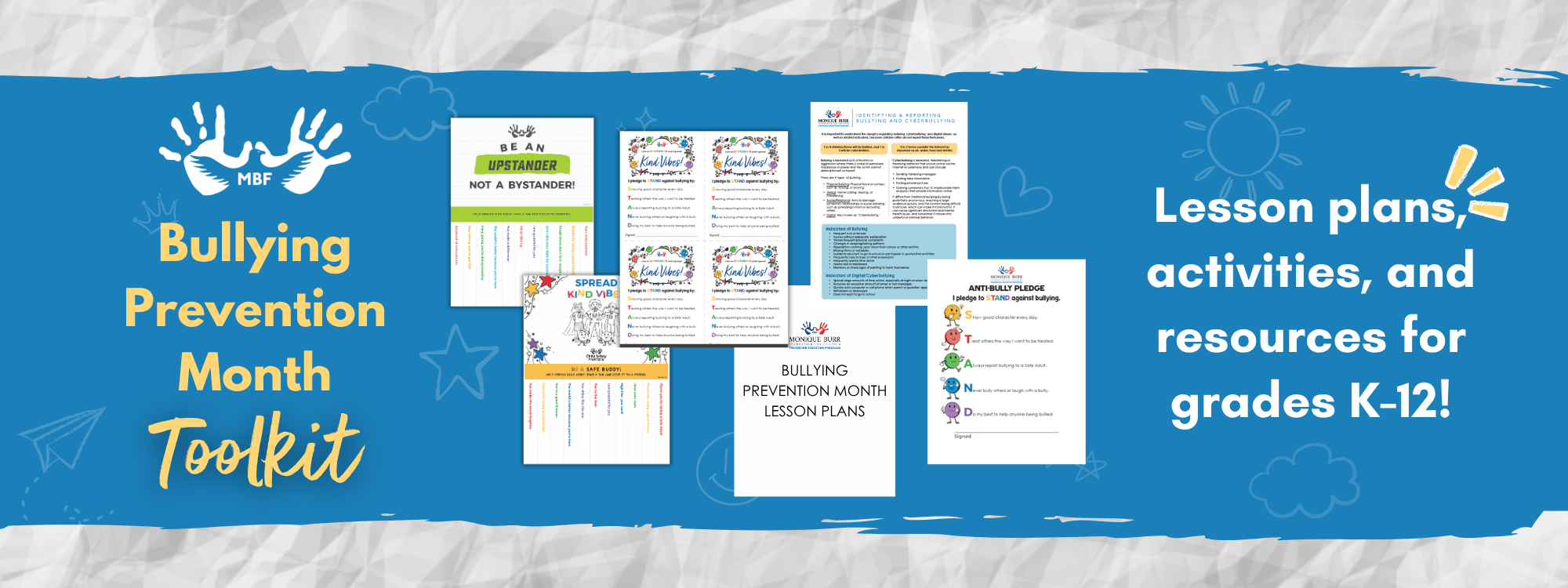
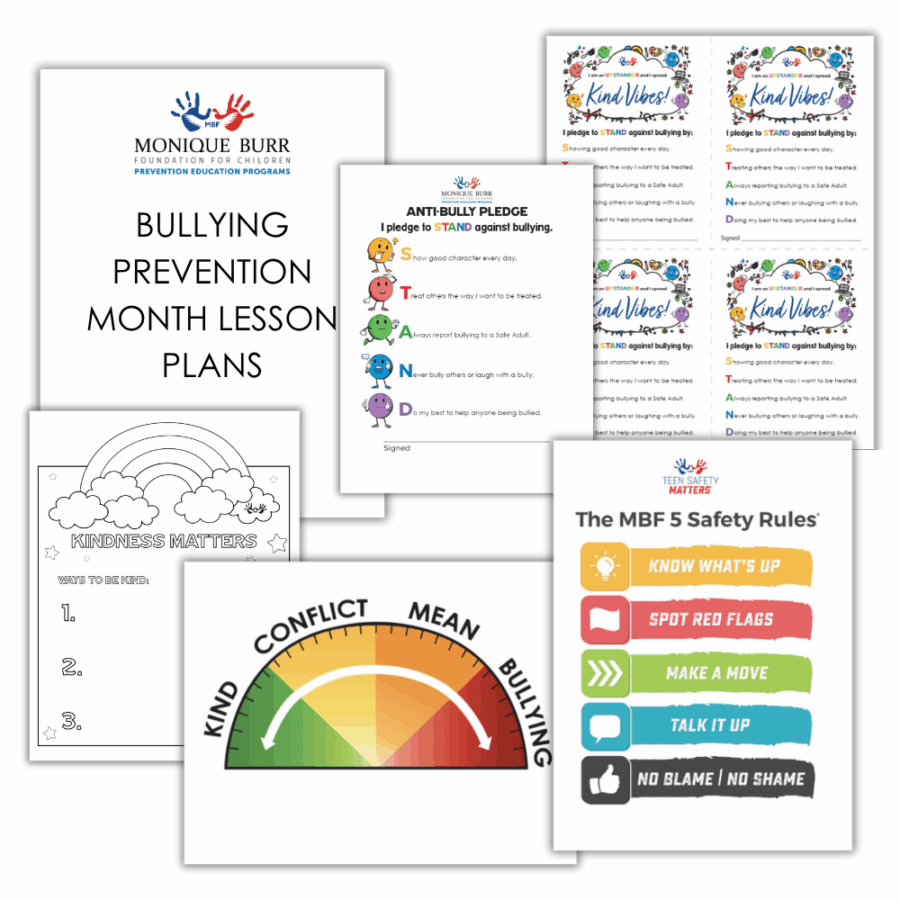
We emphasized these concepts in this year’s Bullying Prevention Month Toolkit, a curated kit of resources to help you celebrate Bullying Prevention Month and cultivate a culture of kindness and safety in your school. Check out the toolkit below and share it with your friends, colleagues, and other school staff!
Paid by OAG, GR-2025-Monique Burr Foundation for Children-00006
LESSON PLANS
(Click each grade level and resource to access)
- Grades K-2 Lesson
- Grades 3-5 Lesson
- Grades 6-8 Lesson
- Grades 9-12 Lesson
SCHOOL RESOURCES
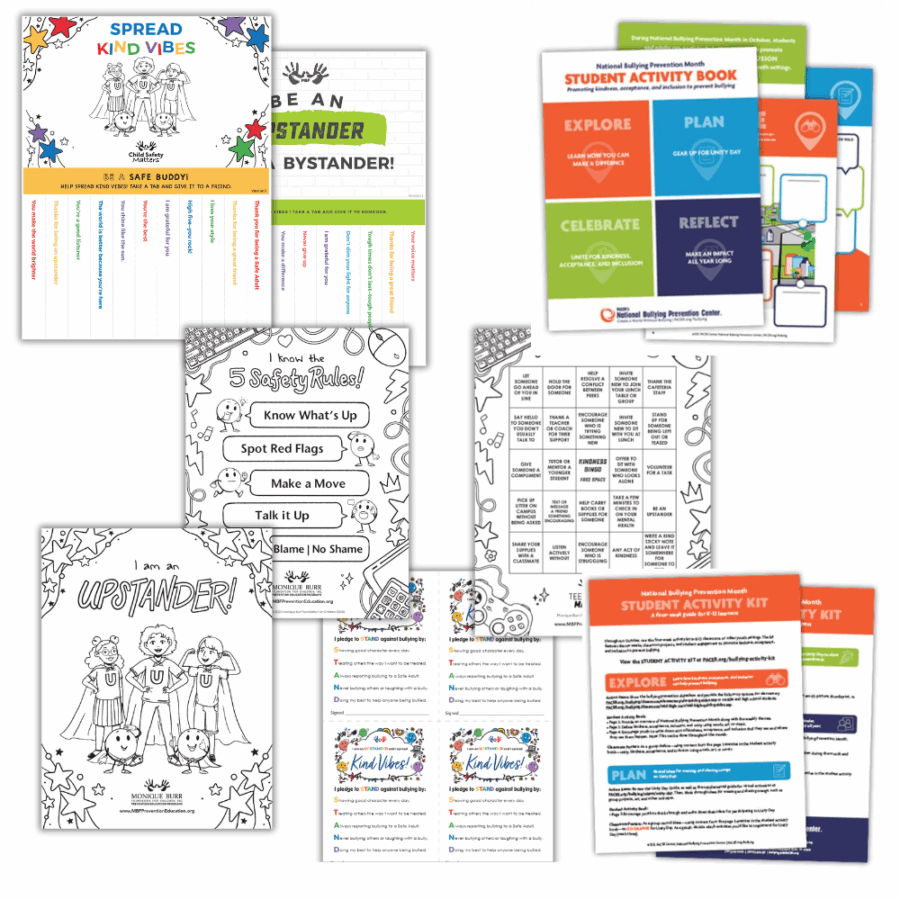
ACTIVITIES/STUDENT RESOURCES
- Coloring Sheets (Grades K-5)
- Safety Rules Coloring Sheet
- We Are Upstanders Coloring Sheet
- Be The Change Coloring Sheet
- Digital/Online Safety Coloring Sheet
- Anti-Bullying Pledge Worksheet (Grades K-5)
- Anti-Bullying Pledge CARDS (Grades K-5)
- Kindness Bingo – CSM (Grades K-5)
- Kindness Bingo – TSM (Grades 6-12)
- Pull Tab Poster (Grades K-5)
- Pull Tab Poster (Grades 6-12)
- National Bullying Prevention Center Student Activity Kit (Grades K-12)
- Student Action Plan Against Bullying Action Plan: English | Spanish
SPIRIT WEEK RESOURCES AND IDEAS
Make friends with someone you don’t know at school (The Week of October 6th)
Messaging:
- If you’ve ever been isolated from others at school or were new and it took time to make friends, you know what it feels like to be left out. Or even if you were never isolated, imagine how it would feel.
- Make friends with someone at school whom you don’t know. You probably wish someone had done that for you.
- Be a leader. Take action and don’t let anyone at school be isolated.
Week of Inclusion (The Week of October 20th)
Messaging:
- Don’t let anyone at school eat alone in the cafeteria or on a school field trip. Make it the week of #NOONEEATSALONE
- Include other students in school activities
- Include other students in after-school activities
- Invite someone you don’t know that well to sit next to you on the bus. Learn about each other.
- At some point or another, each of us has felt insecure, stressed, or alone. It is important to remind our friends and classmates that we are all in it together and we are there to listen and support one another.
Digital Citizenship Week (October 20 to 24)
In the age of AI, helping kids maintain their digital well-being has never been more important. For this year’s Digital Citizenship Week, Common Sense Media created brand-new, updated resources that address these issues with engaging activities that your students will enjoy. Promote digital literacy and citizenship in your classroom using these resources provided by Common Sense Media!
- Digital Citizenship Week calendars
- Fun, daily activities for each grade level, K–12!
- Live webinars and events
- Free self-paced PD courses
- Helpful resources for families
Mix It Up at Lunch Day
Students consistently identify the cafeteria as a place in their school where divisions are clearly and harshly drawn. During your daily announcements, ask students to move out of their comfort zones and connect with someone new over lunch. It’s a simple act with profound implications. Studies have shown that interactions across group lines can help reduce prejudice. When students interact with those who are different from them, biases and misperceptions can fall away, uniting us all (tolerance.org/mix-it-up).
Kindness Landscaping
Have students paint rocks with inspiring messages of kindness. Place the stones around school grounds as landscaping decorations (or for other students to find randomly), creating a visual reminder of the importance and ripple effect of kind words (pacer.org).
Unique Unity Mural
Create a mural for the classroom or school hallway that symbolizes unity. The mural could feature each student drawing a picture, writing a poem or story that depicts the importance of kindness, acceptance, and inclusion, or a photo of each student accompanied by a short statement explaining why it is essential to come together against bullying. A fun, interactive way to bring your school or classroom together against bullying (pacer.org)!
Unity Day
Show that your school is united for kindness, acceptance, and inclusion by making it orange to help end bullying! Come together in one giant ORANGE message of hope and support, WEAR & SHARE ORANGE to color our nation, and even the world, visibly showing that our society believes that no child should ever experience bullying (pacer.org).